
The corporate affairs ministry and the Institute of Chartered Accountants of India (ICAI) are confident of meeting the April 2011 deadline to shift to International Financial Reporting Standards (IFRS).

The government has begun work on expanding the country's National List of Essential Medicines, which was last revised in 2003.
The controversial issue of exclusivity of drug-trial data -- which saw overseas multinational companies and Indian pharma companies taking opposite positions -- is back on the table.

The central government is planning to mandate biometric identification for clinical trial volunteers in the country to bring in global standards and to weed out unethical practices in the industry, which is less than a decade old.

After decades of hunt for fortune abroad, India's pharmaceutical companies now plan to strike gold in their own backyard. Large players from Ranbaxy to Dr Reddy's and Piramal Healthcare are all headed to rural India to boost their revenues.

Ranbaxy has six-month exclusive marketing right to anti-herpes Valtrex.
'It might take 10 years before medicines of decent quality and price reach right down to the last village of India. Ranbaxy, with its India focus, intends to get there in five years.'

Unregistered sources of consignment raise quality questions.

This is in the backdrop of the arrest of R Vasudevan, the seniormost CLB member, on November 24. This has left the board with just two members to hear the pending cases that run into thousands.

Ranbaxy, originally promoted by the Singh family, was acquired by Japan's Daiichi Sankyo late last year.

The IPA complaint turns significant in the backdrop of increasing talk about foreign companies buying into Dr Reddy's, Piramal Healthcare and Aurobindo.

India saw one of the worst terrorist attacks in November last year, when Mumbai was under siege for four days. Little under a year later, Indians perceive rising food prices as a bigger threat than terrorism.
Till a few months ago, hiring was a strict no-no for investment banks. On the contrary, they were scaling back staffing plans in India given the dearth of merger and acquisition activity and stagnant capital markets.That is changing rapidly with a rising number of deals fuelled by strong growth in the markets and an improving economic environment.
Institute of Chartered Accountants of India has sought broad-ranging information about the association of its member institutions with foreign auditing firms.The move assumes significance following the accountancy fraud by the promoters of Satyam Computers that brought the role of auditors under scrutiny. The auditors concerned were associate firms of international auditing entity PricewaterHouseCoopers.
Last month saw 30 companies filing their draft red herring prospectuses with the market regulator for initial public offers , a sharp increase from six in August and three in July this year. The Securities and Exchange Board of India received eight filings in September last year, the month the Lehman Brothers meltdown brought the world economy to its knees.
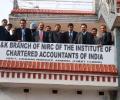
There are three Price Waterhouse firms and four Price Waterhouse & Co firms in PriceWaterhousCoopers' network of firms in India. Each firm is a separate partnership firm, with a maximum of 20 partners each, with head offices in the cities in which they are registered. Each of these is registered with ICAI. The Pricewater House registered in Bangalore had audited Satyam.

M&As are back on the radar for Indian companies, but with two vital changes. First, the average size of the deals are much smaller compared to the earlier years; and second, overseas acquisitions have taken a backseat.

Promoters Narendra Patni and his younger brothers Gajendra and Ashok hold equal stakes totalling 48.3 per cent in India's sixth largest software exporter.
Although India is the second largest generator of environment-friendly projects, domestic firms, public and private, are shying away from maximising the monetary benefits derived from such carbon emission reductions. The country, which is second only to China in terms of generating of carbon credits through the introduction of low polluting technologies, ranks very low when it comes to encashing of these credits through carbon trading.

The government had removed all directors related to the Raju family from the board of Satyam before it was handed to the Mahindra group.
 © 2026 Rediff.com - Investor Information - Advertise with us - Disclaimer - Privacy Policy - Sitemap - Feedback - About us - Terms of use - Grievances